
Case Study – Cold Weather Nitrification for Winona, MN

Cold Weather Nitrification
THE CHALLENGE:
Winona, Minnesota
How do you remove a pollutant that your plant was never designed for? That’s the all-too-common question operators like those at the Winona WWTP ask themselves. The Winona facility was constructed in the 1970s and was initially designed for BOD and TSS removal only. Today, the facility is facing a new limit for ammonia and total nitrogen in its next permit cycle. The facility recently decommissioned its aging trickling filters, further reducing its ammonia treatment capacity.
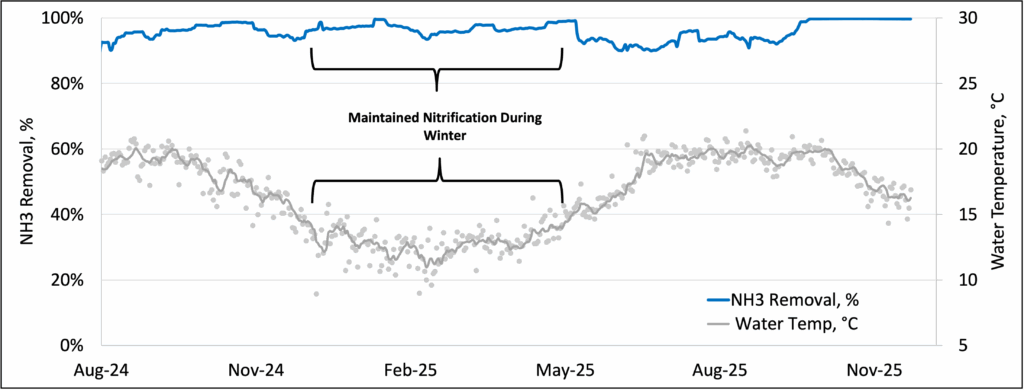
While nitrifying in the summer may not be too difficult, the cold Minnesota winter yields wastewater temperatures dipping below 10 °C. Typical solutions to winter nitrification would require the facility to operate with a high SRT to maintain the nitrifier population. At this facility, the high M LSS required for sufficient SRT would exceed the clarifier solids loading capacity. This meant the facility would need to expand its treatment capacity to meet the upcoming limits. Through preliminary engineering estimates, the cost to expand the facility for year-round nitrification proved infeasible. Thus, the city began to look for alternatives that could help them achieve year-round nitrification, without expanding their treatment volume or clarifier capacity.
WHY THE MOB PROCESS WAS CHOSEN:
With the MOB Process retrofit, the Winona WWTP achieved complete nitrification through the coldest months of the year with just a 4-day SRT. This was accomplished without operating the trickling filters before the activated sludge process. The low SRT allowed the facility to operate within its clarifier solids loading-rate capacity and did not require any new treatment volume.
With the MOB Process added, slow-growing nitrifiers attach themselves to the BioKarrier media and develop robust biofilms. These biofilms are retained in the system by a BioKarrier retention screen, creating an extended SRT for the biofilms, while the suspended biomass is allowed to operate at a low SRT. The MOB Process provided other benefits to the facility as well, including improved settleability and quicker recovery from process upsets. Ultimately, choosing to permanentize the MOB Process was an easy decision.
WHAT WAS ACHIEVED:
- Rapid Results: Average NH3 < 1.0 mg/L
- Complete Nitrification: Less than 10 °C water temperature in winter months
- Rapid Installations: Zero facility downtime to implement MOB Process
- Resilience to spike nitrogen loads
Let us help you achieve your treatment goals!
Call: (919) 615-1205 | Email: sales@nuvodaus.com